





 Canada
 UK
UK France
 Australia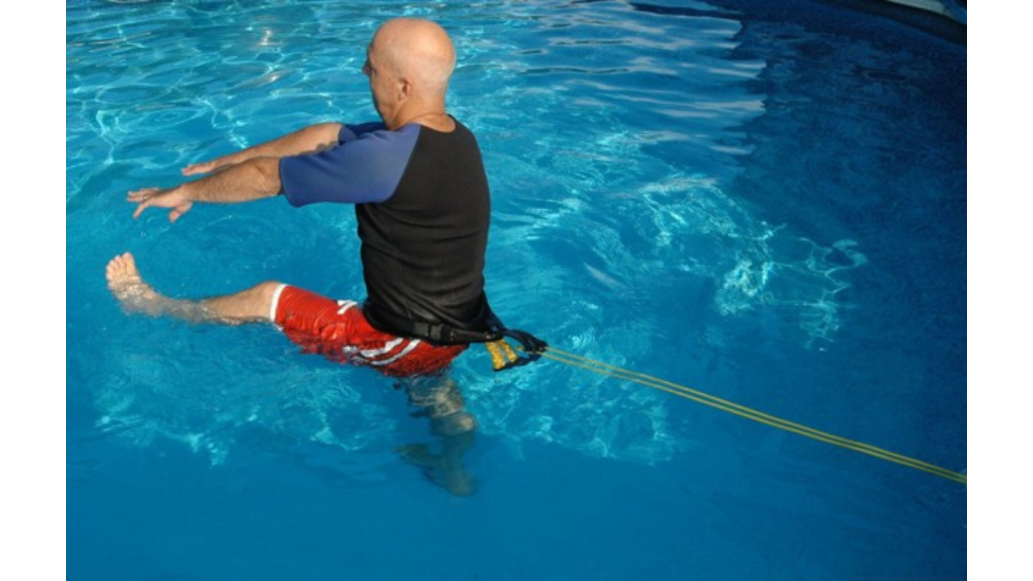
Aquatic training can be a fun and engaging way to train the body when land exercises may not be viable. Balance and fall prevention training can be difficult for individuals who have pain, joint loading limitations, lower limb weakness, and/or a fear of falling. Aquatic exercises change the training environment: water’s buoyancy off-loads the joints while water resistance slows the body movements and adds muscular demand1. Current reviews suggest that aquatic programs can improve selected balance and functional outcomes in older adults2,4.
For clinicians, the most useful aquatic framework may be to use aquatic exercise as the graded entry point for strength, balance, and movement confidence, then transfer those gains to land-based activities.
Key Takeaways
- Aquatic environments provide a broad potential for physical rehabilitation applications1
- Water’s buoyancy effectively reduces weight bearing load1,4,5
- Water adds multidirectional resistance for velocity-dependent motions that can increase muscular demand1
- Aquatic exercise is an excellent bridge to land-based activities, especially for those who are unable to support their body weight while standing, make lateral stepping actions, and/or reaching out without falling
Table of Contents
- How Water Changes the Training Environment
- What Does Current Evidence Say
- Aquatics as a Bridge to Land: Practical Balance and Strength Progressions
- Recommended Products
- Conclusion
- Medical Disclaimer
How Water Changes the Training Environment
1) Buoyancy. Water’s buoyancy is one of the main advantages to aquatic training for individuals who have pain while loading the joints and/or who are unable to stand for extended periods of time on land. The upward pressure of the water counteracts gravity and decreases body weight ~50% at waist level, ~75% at chest level, and ~90% at neck level6,7. Joint unloading allows for exercises relevant to balance, including side steps, weight transfer, walking, stepping, and reaching, to be tolerable for individuals who cannot do them on land. Furthermore, it can provide the opportunity for individuals who can’t tolerate standing long enough to do any of these exercises a chance to do so. Buoyancy also mitigates the consequences of a fall. Relieving this consequence of hitting the ground provides individuals who fear falling to build up the confidence necessary to shift into more complex movements before trying them on land.
2) Resistance. Water applies multidirectional resistance to the limbs submerged1. For clinicians, this adds a tolerable external ‘weight’ without required equipment, while tools like resistance bands and water resistant weights can most certainly be added as a progression. Even while simply standing, a clinician can add turbulence to the water for a global perturbation to the body that requires a person to maintain upright posture while the water pushes on them in different directions3. The water’s resistance adds velocity-dependent load to major muscle groups relevant for upright balance control. As the lower body is submerged, for example, additional work is required for the hip musculature to control stepping and locomotion.
3) Engagement. Motivation is a factor for individuals aiming to improve their physical function, especially when barriers such as pain or fatigue play a role. While not universal, water training can be especially motivating for individuals who enjoy being in the water and experience a form of training that is not typically accessible.
What Does Current Evidence Say?
Two systematic reviews and meta-analyses looking into 1) aquatic exercises on balance, gait, and reduced fall related outcomes, and 2) aquatic exercises compared to land exercises were recently published in 2023 and 2024. The 2023 article by Melo et al. found 11 studies including 395 older adults that looked specifically at balance outcomes including balance, gait, quality of life, and reducing fall-related outcomes compared to control (either land or no exercise). While aquatic physical therapy studies showed better outcomes than controls on functional reaching and mobility assessment scales, the authors mention concerns in study biases. It is interesting, nonetheless, that aquatic therapy outcomes showed a significant increase in anterior reaching by 6.36cm4, indicating that those who did the aquatic training could safely reach further. Although this was taken from a small sample size, this improvement could translate to safer tasks in daily life, especially around common activities that include reaching for something, e.g. dishes.
The second review by Deng et al. in 2024 included 29 randomized trials involving 1486 older adults comparing aquatic therapy with land-based therapy. In their review, they found improvements in the Berg balance scale and the 30 second chair stand test, while noting no significant difference in the 6-min walking test and the Timed Up to Go (TUG). To note, Melo et al. (2023) also noted no changes in TUG during their analysis.
Taken together, these findings across multiple studies highlight that aquatic training is a credible alternative to land-based balance activities. They do not suggest superiority over land-based balance training but provide a valuable insight into making balance improvements in an environment where the difficulty of training may not be accessible to the person otherwise. Furthermore, it is hard to ignore the motivational effects aquatic training may have on those who would otherwise be sedentary.
Aquatics as a Bridge to Land: Practical Balance and Strength Progressions
While swimming itself is an excellent cardiovascular and endurance exercise, for balance and fall prevention the recommendation would be to perform activities relevant to upright balance control.
Clinical dosing guidance:
A reasonable evidence-aligned starting framework is 40 minutes per session, at least twice weekly for 12 weeks. This clinical framework is drawn from studies that implemented aquatic training in their protocols3,5. There is currently no single optimal dose.
Starting point:
- 40 minutes per session
- 2 days per week
- Forward, backward, lateral, tandem walking
- Turbulence while making forward and lateral steps
- Hip adduction/abduction, hip extension, squats, heel raises, hamstring curls
- Reaching, ball throwing/catching
Progression goal:
- 50 min per session
- 3 days per week
- Moving from deeper water (e.g. mid chest level) to shallower (e.g. waist) as pain/strength allow
- Adding weights: ankle weights, hand weights
- Moving away from handrail assistance when applicable
Example Framework:
~Warm Up
- 5 minutes
- Marching, lateral steps, core rotations
~Strength and Control
- 10 minutes
- Hip Abduction/adduction, hip extension, squats, heel raises, hamstring curls
~Dynamic Balance and Gait
- 15 minutes
- Backward, lateral, forward, and tandem walking. Turns. Reaching.
~Reactive Balance
- 5 minutes
- Catching/throwing a ball
~Cool Down
- 5 minutes
- Slower walking, breathing, stretching
Recommended Products
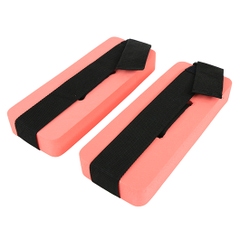
- CanDo Aquatic Ankle Cuffs – for progressing hip abduction/adduction, hip extension, and hamstring curls in water
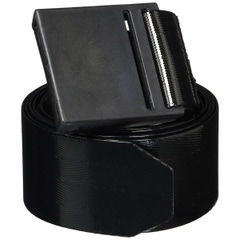
- Sammons Preston Economy Quick Clean Gait Belt + THERABAND High Resistance Bands – for adding additional resistance to the center of mass via hooking the bands to the gait belt during walking forward, backward, and lateral



Conclusion
Aquatic training for physical rehabilitation has evidence-based merit and can be a great alternative to traditional balance and fall prevention exercises. Although the evidence does not support a consistent favoring of aquatic training over traditional land-based training, individuals who are unable to train balance due to reasons such as pain or lower limb fatigue may see benefits from aquatic training as a means of off-loading the joints and water-resisted movements. Water training may also be an additional motivating factor for those who inherently enjoy being in water.
References
- Becker, B. E. (2009). Aquatic Therapy: Scientific Foundations and Clinical Rehabilitation Applications. PM&R, 1(9), 859–872. Portico. https://doi.org/10.1016/j.pmrj.2009.05.017
- Deng Y, Tang Z, Yang Z, Chai Q, Lu W, Cai Y, Luo Y, Zhou Y. Comparing the effects of aquatic-based exercise and land-based exercise on balance in older adults: a systematic review and meta-analysis. Eur Rev Aging Phys Act. 2024 May 19;21(1):13. doi: 10.1186/s11556-024-00349-4. PMID: 38764039; PMCID: PMC11102618.
- Melzer, I., Elbar, O., Tsedek, I. et al. A water-based training program that include perturbation exercises to improve stepping responses in older adults: study protocol for a randomized controlled cross-over trial. BMC Geriatr 8, 19 (2008). https://doi.org/10.1186/1471-2318-8-19
- Melo RS, Cardeira CSF, Rezende DSA, Guimarães-do-Carmo VJ, Lemos A, et al. (2023) Effectiveness of the aquatic physical therapy exercises to improve balance, gait, quality of life and reduce fall-related outcomes in healthy community-dwelling older adults: A systematic review and meta-analysis. PLOS ONE 18(9): e0291193. https://doi.org/10.1371/journal.pone.0291193
- Nissim, M., Livny, A., Barmatz, C. et al. Effects of aquatic physical intervention on fall risk, working memory and hazard-perception as pedestrians in older people: a pilot trial. BMC Geriatr 20, 74 (2020). https://doi.org/10.1186/s12877-020-1477-4
- Pöyhönen T, Avela J. Effect of head-out water immersion on neuromuscular function of the plantarflexor muscles. Aviat Space Environ Med. 2002;73(12):1215–1218. [PubMed] [Google Scholar]
- Pöyhönen T, Keskinen KL, Hautala A, et al. Human isometric force production and electromyogram activity of knee extensor muscles in water and on dry land. Eur J Appl Physiol Occup Physiol. 1999;80(1):52–56. doi: 10.1007/s004210050557. [DOI] [PubMed] [Google Scholar]
Medical Disclaimer: The information provided on this site, including text, graphics, images, and other material are for informational purposes only and are not intended to substitute for professional medical advice, diagnosis, or treatment. Always seek the advice of your physician or other healthcare professional with any questions or concerns you may have regarding your condition.