





 Canada
 UK
 France
 Australia

Shoulder rehabilitation often focuses on restoring range of motion while gradually rebuilding strength and muscle function. Understanding shoulder muscle activation and how tools such as shoulder pulleys can support movement may help clinicians select appropriate exercises throughout the rehabilitation process.
Shoulder Muscle Activation Levels During Range of Motion Exercises
Shoulder rehabilitation patients often perform range of motion exercises using shoulder pulleys and bars. These active-assisted exercises are often used as the next step in shoulder rehabilitation after passive range of motion (ROM) exercises. Active-assisted range of motion (AAROM) exercises are usually performed to begin muscle activation when it's important to protect healing tissue, especially after shoulder surgery.
Researchers wanted to compare muscle activation during different AAROM exercises. They divided 11 forward shoulder elevation exercises into 3 types: gravity minimized, upright assisted, and upright active. 15 healthy subjects performed these exercises in random order while EMG levels were collected in the anterior deltoid, supraspinatus, and infraspinatus. The authors measured maximal activity of these muscles to determine the greatest demand on healing tissue. Each exercise was performed at 30 degrees per second.
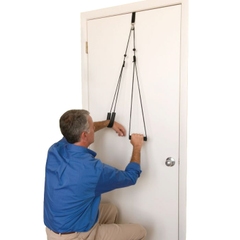
During the shoulder pulley exercises, the subjects raised their dominant arm by allowing the non-dominant hand to primarily assist arm elevation. Standing active forward elevation produced the highest maximal levels of muscle activation. The exercise produced an average activation level of 17%, 14%, and 31% MVIC (maximum voluntary isometric contraction) of the supraspinatus, infraspinatus, and anterior deltoid, respectively. Their findings of activation levels during rope-and-pulley exercises were consistent with those of Dockery and colleagues (1998), who found similar activation levels.

Table: %MVIC of muscle activation during shoulder pulley forward elevation AAROM in healthy subjects.
The subjects also performed a supine exercise with a Red THERABAND resistance band starting with the shoulder flexed to 90, externally rotated, and elbow straight. They actively moved the arm to 160, lengthening the band and slowly returning to the starting position. Interestingly, the supine THERABAND exercise produced less EMG activation than the shoulder pulley exercise at 8%, 13%, and 15% of the supraspinatus, infraspinatus, and anterior deltoid, respectively.
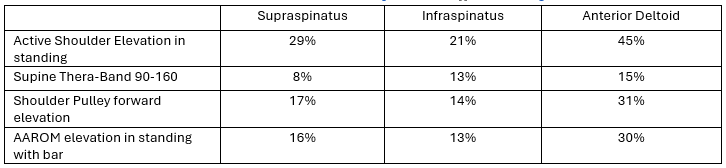
Table: %MVIC of muscle activation during other ROM exercises in healthy subjects.1
The authors found that all gravity-minimized activities including the THERABAND 90-160 flexion exercises would be appropriate in the earliest stages of a rehabilitation continuum to regain active motion. Furthermore, these exercises would be a good first-step in progressing patients from passive ROM to active-assisted ROM exercises. The authors also concluded that upright assistive exercises using a shoulder pulley produced low-to-moderate activation levels.
All exercises produced lower EMG activation than active shoulder elevation to 160 in the scapular plane. The authors noted that exercises that protect the supraspinatus and infraspinatus don't have to be progressed first in gravity-minimized, then upright active-assisted ROM exercises since low levels of activation (<20%) were seen during those exercises. However, patients who need to protect the deltoid (particularly after open rotator cuff repair) should perform gravity-minimized exercises first, then upright-assisted.
In conclusion, shoulder pulley exercises produce low levels of activation in the rotator cuff (14-17%) and moderate levels in the deltoid (31%). The supine THERABAND exercise from 90 to 160 produced 8% to 13% rotator cuff activation, and 15% deltoid activation. Clinicians can use this information to make better clinical decisions for exercise prescription in post-operative shoulder patients.
Should Pulleys be Used for Rotator Cuff Rehabilitation Exercise?
While shoulder pulleys have classically been used to improve range of motion and re-establish strength, there has been a rising concern that rope and pulley exercises may be hurting more than helping. The accusation lies in the potential of excessive scapular motion and the damage it may cause during the recovery process.
Baumgarten and colleagues set out to bust this myth once and for all. In their study, they theorized:
“Rotator cuff repair patients treated with pulley exercises would have increased scapular substitution and inferior patient-determined outcome scores, range of motion, and strength compared with patients treated with an alternative rehabilitation program without pulleys."2
A total of 53 patients were chosen to participate in this study. All post-operative rotator cuff repairs, they were randomly divided into two separate groups: 27 to a rehabilitating using pulleys, 26 patients without pulleys. The outcomes of their rehabilitation were measured at weeks 6, 12, 18, 26 and 52, determined by:
- Patient-determined outcome
- Range of motion
- Scapular substitution
- Strength
After the intervention, the researchers confidently determined that “A rotator cuff repair rehabilitation program that uses pulleys does not result in inferior outcomes."2
- Both groups yielded statistically significant improvements in the patient-determined outcome tests.
- Both interventions demonstrated improvements in shoulder flexion, abduction, external rotation, strength, and scapular substitution over time after rotator cuff repair.
- There was no difference in range of motion, strength, or scapular substitution between interventions.
Bonus Exercise: Pulley Shoulder Internal Rotation
Exercise Instructions
- Step One
- Secure the pulley over the top of the door.
- Step Two
- With your back to the door, grasp one handle with your injured side behind your lower back with your elbow slightly bent.
- Step Three
- Grasp the other handle with your uninjured arm overhead.
- Step Four
- Pull down with the uninjured arm, stretching the injured arm.
- Step Five
- Hold and repeat.
Recap
Shoulder rehabilitation requires the right balance of mobility, muscle activation, and progressive exercise. Understanding how the shoulder muscles respond during range-of-motion exercises and how tools like shoulder pulleys can support movement may help clinicians select appropriate exercises for rotator cuff rehabilitation and overall shoulder recovery.
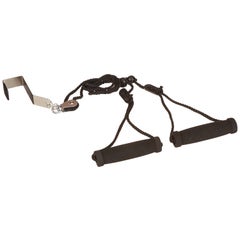
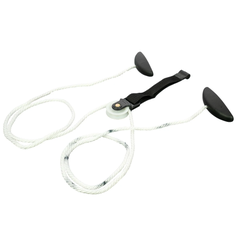
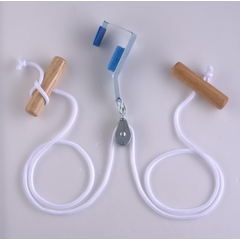
Recommended Shoulder Pulleys



References
- Gaunt BW, et al. An electromyographic evaluation of subdividing active-assistive shoulder elevation exercises. 2010. Sports Health. 2(5):424-432.
- Baumgarten KM et al. 2016. Are Pulley Exercises Initiated 6 Weeks After Rotator Cuff Repair a Safe and Effective Rehabilitative Treatment? A Randomized Controlled Trial. Am J Sports Med. 44(7):1844-51
Medical Disclaimer: The information provided on this site, including text, graphics, images, and other material are for informational purposes only and are not intended to substitute for professional medical advice, diagnosis, or treatment. Always seek the advice of your physician or other healthcare professional with any questions or concerns you may have regarding your condition.