






 Canada
 UK
 France
 Australia

Across a range of care settings, from Veterans Affairs (VA) and rehabilitation to long-term, home, and senior care, diabetic foot assessment should produce a workable prevention plan—not simply a completed screening record.
Where Standard Screening Can Miss Risk
Asymptomatic does not mean low risk
Neuropathy can be asymptomatic. Distinguish identifying loss of protective sensation (LOPS) from excluding neuropathy altogether.
A normal 10-g monofilament response does not necessarily exclude earlier, small-fiber neuropathy. Monofilament findings should be considered within a broader clinical assessment and applicable guidelines.1
Today’s skin findings do not capture cumulative risk
Once LOPS or peripheral artery disease (PAD) is identified, assess previous ulceration or amputation, end-stage renal disease, deformity, joint mobility, callus, and pre-ulcerative lesions. Intact skin does not erase cumulative risk.2
PAD can be clinically quiet—and ABI has limitations
PAD may not always present with typical symptoms, particularly when neuropathy or limited mobility affects symptom recognition. The ankle-brachial index (ABI) can also have limitations in some patients with diabetes or chronic kidney disease due to arterial calcification. Clinical guidelines address when additional vascular assessment may be appropriate when ABI results are unreliable or difficult to interpret.3
Match Follow-Up to the Risk Category
The International Working Group on the Diabetic Foot (IWGDF) framework can be used to match planned screening frequency to ulcer risk—not to set the management schedule for an active wound. LOPS = loss of protective sensation; PAD = peripheral artery disease.5
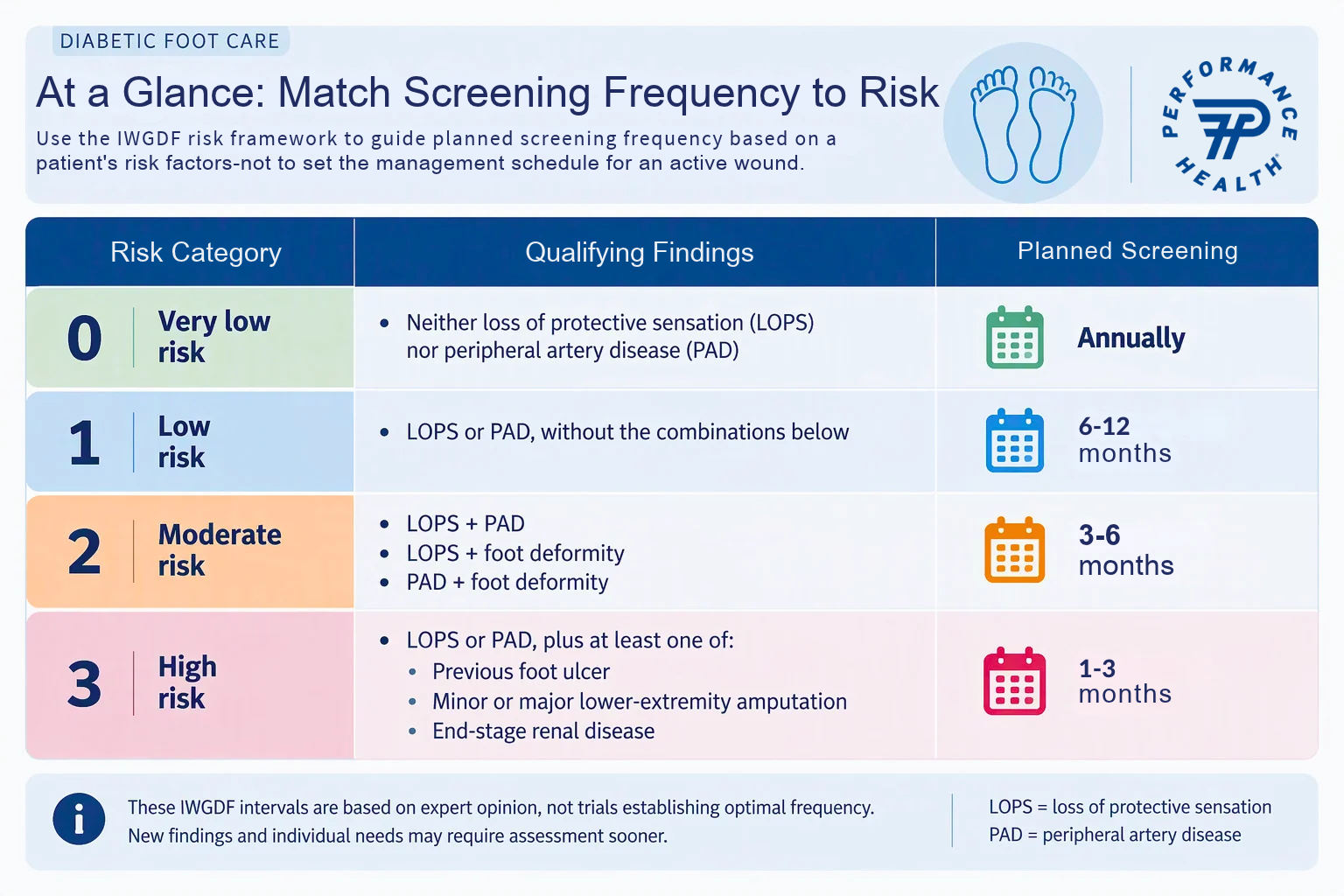
These IWGDF intervals are based on expert opinion, not trials establishing optimal frequency. New findings and individual needs may require assessment sooner.5
Make the category operational
Consider documenting the risk category, supporting findings, next review date, and responsible service. Keep risk separate from current skin status: “healed” does not mean “low risk.” Follow-up may also account for changes in footwear use, callus, deformity, renal status, function, and ability to follow the plan.
For moderate- and high-risk patients, IWGDF recommends integrated professional foot care, appropriate footwear, and structured education. Focus on consistent delivery rather than repeating examination technique.2
Keep assessment tools in their clinical role
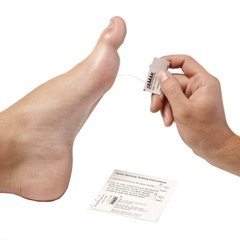
Use tools such as Jamar Disposable Monofilaments within a standardized protocol, with the specified test force and applicable instructions. A sensory result alone does not establish overall ulcer risk.
Adapt Prevention to the Care Setting
The following workflows are suggestions for local adaptation, not validated protocols or claims of improved outcomes.
Long-term care: pressure exposure does not require walking
Non-ambulatory residents need pressure-injury prevention alongside diabetic foot-risk assessment. Heels may remain loaded during bed rest even on pressure-redistributing surfaces. Heel-specific guidance supports keeping at-risk heels free of the support surface, with appropriate lower-leg support and positioning.6
A care-transition checklist might include: current heel protection, positioning, device contact areas, and whether protection stays in place. Reconcile device instructions with standing and transfer needs.
Rehabilitation: progress mobility without losing foot protection
Separate functional progression from permission to increase loading. Rehabilitation planning may need to account for weight-bearing orders, footwear/offloading requirements, transfer strategy, and activity changes. Care teams can also consider how foot protection will be maintained during routine mobility outside supervised therapy.
After a healed plantar ulcer, maintain prescribed pressure-relieving footwear during walking. Coordinate transitions from active-ulcer offloading with the treating team; there is no universal loading progression in this article.2
Home care: verify who can carry out the plan
Consider complementing patient education with a capability check: who can inspect the whole foot, apply footwear, and notice changes between visits? For caregiver-led inspection, identify a primary person and backup. Consider a demonstration using the actual home setup.
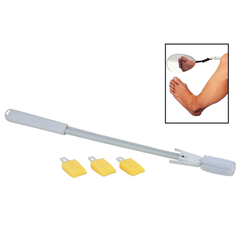
An aid such as Sammons Preston Daily Care Diabetic Foot Care Kit may address reach limitations. Verify reliable use and retain needed caregiver assistance.
Senior care: preserve function while reducing care burden
Pair risk status with vision, dexterity, cognition, balance, and footwear management. Observe donning and doffing. Reassess after functional or support changes, and clarify responsibilities when several caregivers participate.
VA and transitions between settings: make the risk visible
Transfer the risk framework and category, prior-ulcer location, skin status, vascular results and limitations, footwear/offloading plan, mobility restrictions, and next review date. Identify the receiving owner; follow local VA or facility requirements.
After a Healed Ulcer: Plan for Recurrence Prevention
Healing does not erase ulcer history. LOPS or PAD plus previous ulceration places a patient in IWGDF category 3, with planned reviews every 1–3 months.5
Match footwear to the previous pressure problem
For a healed plantar ulcer, IWGDF recommends therapeutic footwear with demonstrated plantar pressure relief during walking and consistent indoor/outdoor use. “Comfortable” or “diabetic” footwear is not equivalent to documented pressure relief.2
Explore unprotected steps, nighttime transfers, fastening difficulties, and changing fit. Record barriers and agreed responses. Review the prior ulcer site and other pressure areas—not only whether the original wound remains closed.
Keep professional preventive care active
Continue professional management of excess callus and pre-ulcerative lesions within integrated preventive care. Recurrence prevention is not simply another self-care handout.2
Build the post-healing handoff before wound care ends
Before wound care ends, document the healed site, persistent risks, footwear availability, mobility plan, and next preventive appointment. Assign responsibility for reviewing fit, pressure concerns, and adherence after discharge or changes in walking demands.
Keep product selection separate from outcome claims
Consider options such as the Vasyli+Armstrong II Sensitive Feet Orthotic within individualized assessment. Product inclusion does not establish pressure relief at a previous ulcer site or prevention of recurrence. Match selection and fit to clinical findings and footwear compatibility.
Veterans With Diabetes and Foot Complications
Diabetes affects nearly 25% of VA’s patient population and is the leading cause of amputation among VA patients—not a statistic for all U.S. Veterans.7
VA’s Prevention of Amputation in Veterans Everywhere (PAVE) program provides a multidisciplinary framework for Veterans at risk of primary or secondary limb loss. Preserve risk status, footwear needs, and the prevention plan across care transitions.8
VA recognizes type 2 diabetes as presumptively associated with qualifying Agent Orange exposure. 9 For early-onset peripheral neuropathy, the presumption requires onset within one year of exposure and at least 10% disability under VA rating regulations. These benefits criteria do not establish the cause of every later neuropathy.10
Make Prevention Work Between Encounters
Assessment should lead to an interpretable risk category, review intervals, feasible protection strategy, and clear ownership. Ask not only “Was screening completed?” but “What changes because of the findings?”
Support Diabetic Foot Care Across the Continuum
Assessment tools, adaptive foot-care aids, and orthotic options should support—not substitute for—an individualized clinical plan.
Explore more diabetes care products to find more solutions for assessment, prevention, daily care, and patient support.
Products Recommended in this Article



References
- Malik RA. Is the 10 g monofilament fit for purpose for diagnosing DPN? BMJ Open Diabetes Research & Care. 2023;11:e003773.
- IWGDF. Guidelines on the prevention of foot ulcers in persons with diabetes, 2023 update.
- Canadian Cardiovascular Society. Peripheral Arterial Disease Guideline: Diagnosis and Screening. 2022.
- Soyoye DO, et al. Diabetes and peripheral artery disease: A review. World Journal of Diabetes. 2021;12(6):827–838.
- Registered Nurses’ Association of Ontario. Diabetic foot ulcers: Prevention, assessment and management, third edition. Appendix E: IWGDF risk stratification system.
- NPIAP/EPUAP/PPPIA. Preventing Heel Pressure Injuries. International Guideline, fourth edition. Chapter version September 11, 2025.
- VA Office of Research and Development. VA research on Diabetes.
- Veterans Health Administration. Directive 1410: Prevention of Amputation in Veterans Everywhere Program. June 30, 2022.
- VA. Agent Orange exposure and disability compensation.
- VA Public Health. Peripheral Neuropathy and Agent Orange.
Online clinical and VA references accessed November 3, 2026. Recommendations require application to the individual patient and local clinical protocols; workflow examples in this article are not validated outcome claims.
Medical Disclaimer: The information provided on this site, including text, graphics, images, and other material are for informational purposes only and are not intended to substitute for professional medical advice, diagnosis, or treatment. Always seek the advice of your physician or other healthcare professional with any questions or concerns you may have regarding your condition.