





 Canada
 UK
UK France
 Australia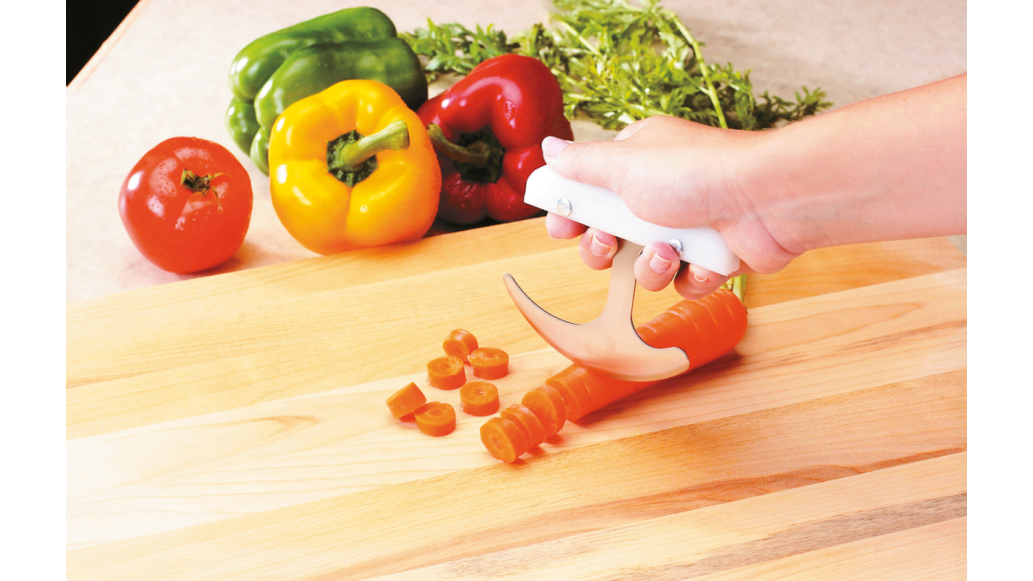
Feeding and dining sit among the most fundamental activities of daily living, and among the easiest to leave out of a plan of care, even when the referral points straight at the hand. A patient referred for hand pain is, by definition, a patient whose meals and food preparation have become harder. Adaptive equipment for eating and cooking is traditionally occupational therapy territory, and OT should lead the formal ADL evaluation and retraining. But the physical therapist treating that hand is well-positioned to recognize how the impairment plays out at the table and point toward a solution.
Difficulty at the table and the counter is usually a physical problem with a physical explanation. Once the impairment is identified, the right tool is often a low-cost, immediately available way to restore independence.
Table of Contents:
What the Physical Therapist Sees at the Table
The referral says hand pain. It does not say feeding. But the two are inseparable: eating and cooking are among the most hand-intensive tasks a person performs in a day, and the impairment driving the referral is the same one that makes a fork or a jar difficult. Hand pain is not the only physical route to a difficult meal, and the wider set of impairments is worth keeping in view, because a PT assesses all of them routinely.
Grip is the first thing to look at. Grip strength, and the grip force a patient can produce without pain, together determine whether they can hold a standard utensil, with its narrow handle and its demand for a forceful, sustained grasp. Hand and wrist range of motion matters just as much: a narrow handle takes considerable finger flexion to surround, and limited ROM at the MCP, PIP, and DIP joints, common to both osteoarthritis and rheumatoid arthritis, can make that grasp difficult or impossible1. Joint pain is a separate problem from weakness; a patient may have the strength and the motion but be unwilling to load an inflamed first carpometacarpal or finger joint across a whole meal. Coordination is another factor: the tremor, dysmetria, and unsteadiness seen in Parkinson disease, essential tremor, ataxia, and post-stroke presentations. Proximal strength and endurance count too, since cooking is sustained and often done standing.
This is the same hand and upper extremity examination a PT performs constantly. The only shift is to ask whether what you are seeing also shows up at the table.
Arthritis: Lowering the Load on the Joint
For the patient with hand osteoarthritis or rheumatoid arthritis, joint protection should frame every recommendation: reducing the force, the pinch, and the sustained load placed on vulnerable joints during functional tasks2. Adaptive equipment applies that principle directly, and assistive devices are a recommended, evidence-supported component of conservative osteoarthritis care3,4.
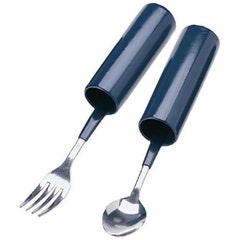
A standard utensil handle is narrow, forcing near-full finger flexion and a forceful grip to keep it from rotating. A wider, built-up handle takes less flexion to surround and far less grip force to control, which offloads the small joints of the hand. The Coated Built-Up Handle Utensils come in graded handle diameters, so the fit can be matched to a patient's available ROM.
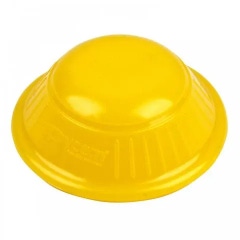
The same logic applies in the kitchen. Opening a jar is a high-force, high-torque demand on the joints arthritis compromises most. A Dycem Multi-Purpose Jar Opener gives a high-friction gripping surface that cuts the grip force needed to generate torque and removes the pinch on a slick lid. It turns a task many patients abandon, or injure themselves attempting, into a manageable one.
Grip and Coordination
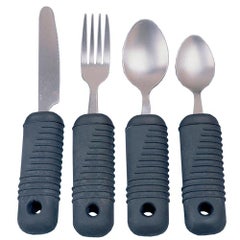
When weakness rather than pain is the limiting factor, the target shifts to the security of the hold. A patient with a weak grasp can often position a utensil but cannot sustain enough force to keep it steady through a meal. A built-up handle helps, and a ribbed handle helps further: it accommodates a range of grip patterns and gives the hand purchase without a strong, closed grasp. The Sammons Preston Sure Grip Utensils have a ribbed built-up handle that allows several functional grip positions for a weak or inconsistent grasp.
Incoordination is a different problem. For the patient with tremor or dysmetria, the issue is control rather than force: the utensil reaches the mouth, but not cleanly. Weighted utensils are a long-standing response. Added mass can attenuate tremor amplitude and gives proprioceptive feedback, and assistive technology of this kind is an established part of non-pharmacological tremor management5. The response is individual. Some patients with tremor do better with added weight and some do not, so weighted utensils such as the Sammons Preston Weighted Utensils should be trialed rather than assumed.
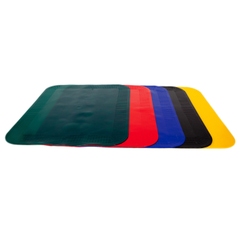
Coordination problems extend to what is on the table, not only what is in the hand. A patient who cannot reliably stabilize a plate or bowl will chase it across the table, and a one-handed patient has no second hand to hold it. A Dycem Non-Slip Pad under the plate, bowl, or cutting board anchors the item, so the patient's effort goes into the task rather than into holding it still.
Cooking: The Higher-Demand Task
Cooking asks more of a patient than eating does. Where a meal is a series of low-force, repetitive movements, food preparation is sustained, often bimanual, often done standing, and punctuated by high-force demands: cutting, opening, peeling, stabilizing. A patient who manages a fork may still be unable to safely cut an ingredient.
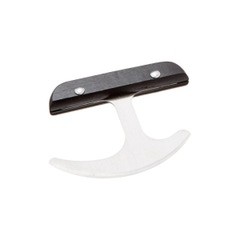
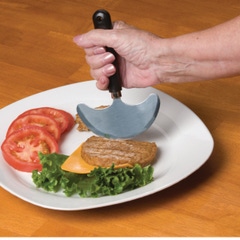
Cutting is the clearest example. A standard knife requires a firm grip, repetitive wrist motion, and downward force, and for a patient with hand arthritis, grip weakness, or the use of one hand, it is both difficult and a laceration risk. A Rocker Knife cuts with a rocking motion through a T-shaped handle held in the palm rather than the fingers, which reduces the grip force and wrist motion required, allows one-handed use, and lowers the injury risk. With a non-slip pad under the cutting board, one-handed or low-force food preparation becomes workable. The jar opener fits this same group of kitchen tools, addressing a common and injurious point of failure at the counter.
Recommending Well
These recommendations stay clinically sound when they follow from the examination rather than the diagnosis. The right device depends on why a task is failing, and pain, weakness, limited ROM, and incoordination each point somewhere different. A patient often has more than one of them. Whatever the assessment suggests should then be trialed in context, because a utensil that works in the clinic can still fail at a patient's own table, and the only way to know is to watch them use it on a real task.
In arthritis, the equipment works best paired with education, since joint protection is a behavior as much as a tool and the device makes more sense to a patient who understands the principle behind it. And because adaptive equipment and ADL retraining are shared territory, occupational therapy should handle the formal feeding evaluation and training. The PT's role is recognition and initiation: noticing the impairment at the table, addressing what is within scope, and referring for the rest.
A Personal Note
This subject is not abstract for me.
Following chemotherapy and immunotherapy, I went through an extended period of hand pain and weakness. I do a lot of cooking, and tasks I had never once thought about turned into tasks I had to think about. Opening a jar became an obstacle, and a Dycem jar opener is something I rely on now. The rocker knife was another tool I used, because cutting with a standard knife asked more of my hand than it could reliably give.
Using these tools changed how I see this category of equipment. It is easy, from the clinic side, to think of adaptive tools as a concession. They are closer to the difference between doing a task and not doing it, between a kitchen that is a daily frustration and one that works. The value of a non-slip jar opener or a well-designed knife is easy to underrate until the day you need one.
It is also why knowing this equipment well matters. We are more useful to patients when we can talk about these tools from familiarity, when we have handled them and know what each one does, instead of naming a category and moving on. Our patients are living the problem. The least we can do is know the solutions in detail.
Product Recommendations
The tools below are current PerformanceHealth.com products. Each is inexpensive and easy to put to use.
Eating, arthritis and limited grip. The Coated Built-Up Handle Utensils for larger-diameter handles that reduce the finger flexion and grip force a standard utensil demands.
Eating, weak grasp. The Sammons Preston Sure Grip Utensils for a ribbed built-up handle that accommodates a weak or inconsistent grip.
Eating, tremor and incoordination. The Sammons Preston Weighted Utensils for added mass that can attenuate tremor, to be trialed with the individual patient.
Stabilizing the plate, bowl, or cutting board. The Dycem Non-Slip Pads to anchor items for one-handed use or for patients who cannot stabilize them.
Cooking, opening. The Dycem Multi-Purpose Jar Openers for a high-friction grip that reduces the force and pinch needed to open jars and bottles.
Cooking, cutting. The Rocker Knife for one-handed, low-force cutting with reduced grip and wrist demand.
Eating and cooking are daily, repeated, and central to both nutrition and dignity. When a physical impairment makes them harder, identifying it and matching it to the right tool is a small step that gives a patient a great deal back.



References
- Hand function and adaptive equipment use in patients with rheumatoid arthritis. 2020. https://pubmed.ncbi.nlm.nih.gov/32281611/
- Current and future advances in practice: practical management of hand osteoarthritis. 2024. https://www.ncbi.nlm.nih.gov/pmc/articles/PMC12536898/
- Kolasinski SL, et al. 2019 American College of Rheumatology/Arthritis Foundation Guideline for the Management of Osteoarthritis of the Hand, Hip, and Knee. Arthritis Care & Research. 2020. https://acrjournals.onlinelibrary.wiley.com/doi/10.1002/acr.24131
- Core Recommendations for Osteoarthritis Care: A Systematic Review of Clinical Practice Guidelines. Arthritis Care & Research. 2023. https://acrjournals.onlinelibrary.wiley.com/doi/10.1002/acr.25101
- Improving Functional Disability in Patients with Tremor: A Clinical Perspective of the Efficacies, Considerations, and Challenges of Assistive Technology. Journal of the Neurological Sciences. 2022. https://www.sciencedirect.com/science/article/abs/pii/S0022510X22000594
Medical Disclaimer: The information provided on this site, including text, graphics, images, and other material are for informational purposes only and are not intended to substitute for professional medical advice, diagnosis, or treatment. Always seek the advice of your physician or other healthcare professional with any questions or concerns you may have regarding your condition.